

Where Do Hares Belong?
A Magical Encounter

What is it like to be at a readthrough of a sitcom? Find out on Friday 19th June (next week!) at around 4pm at The Slaughtered Lamb (seriously) in Clerkenwell, London. That’s when I will be staging a readthrough of my latest sitcom called The Lab, a mainstream studio sitcom set in a forensic lab. It’s CSI-meets-IT Crowd.

It’ll be fun. Funny, hopefully. And sociable, since I’ll be hanging around for a drink afterwards. Interested? I’ve made a little video about it that you can watch over at The Wycliffe Papers (where you will also find jokes):
Where Do Hares Belong?
On Monday, I saw a hare. It was majestic and wonderful.
I’ve been wondering why it was so special and naturally my thoughts turn to the land, the Bible, and England which make it relevant to Cary’s Almanac. I should warn you, however, that this encounter has made such an impression on me that I’ve written two thousand words, twice the length of a normal instalment of the Almanac. You might need a bigger cup of tea. This one could require a full mug before settling down to read.
Let me first explain what happened. I was driving towards Chilton Cantelo. Yes, there really is a village near me called Chilton Cantelo. A short hop in the car opens up all kinds of possibilities for my daily walk.
As I drove along the lane, I saw what I thought was a rabbit by the side of the road. There are plenty of rabbits around this area. I’ve seen dozens on previous walks. But then I wondered if it might be a hare. The ears gave it away, longer and more slender. Hares also have longer frames than rabbits. In no time, the hare had dashed through a gateway into a field. I saw it disappear into the crops of the field and soon it was gone.
By that time, I was sure it was not a rabbit. It was a hare. I was certain, even though I’d not seen one with my own eyes for years. I’d seen one on a menu in a restaurant in Fulham maybe fifteen years ago. But I had not seen one alive and well in the wild since I was fairly young, walking across one of our fields with mum or dad when a hare hurtled across the field at incredible speed.
Hares can run up to 45 miles an hour which means they can outrun almost anything, especially since they can change direction extremely quickly. Hunting them, then, has historically been great sport. Packs of hounds were set on the trail of hares, an outdoor pursuit that was banned by the law against hunting in 2004.
My first encounter with that running hare was probably in the mid-1980s. Hares had already become rare by then. Hunting was not the reason. It was a change in agricultural practices. Hares don’t burrow like rabbits. They put their young leverets in shallow hollows or depressions in the ground called forms. They would be hidden by the tall grass which used to be left to grow for hay. These days, those fields are mown earlier in the year for silage, normally with machines that cut fast and low. You can imagine the effect this would have on a form of leverets.
Hares are rare. So as I watched the hare dart into a field and disappear the other day, I thought to myself that I might never see one again. It’s probably thirty-five years since that previous encounter. In another thirty-five years, I will be eighty-five so probably in not a fit state to wander around fields looking for hares.
But I was wrong. That hare was just the starter, if you’ll pardon the expression. Something magical was about to happen. I parked my car in my usual spot and began my walk. As I wandered along, another hare appeared around a corner and stopped in front of me.
I gazed at it and smiled. It felt like an unexpected bonus. I thought about taking a photograph but worried that the movement would scare it away. Either way, the hare did not linger for long before bounding off leaving me grateful for my double helping of hare.
I walked on a little way, giving thanks to God. He made hares. He made them beautiful and majestic. Rabbits are cute, beautiful in their own way. But they are not majestic. Why is that? I was pondering this when behold! The hare returned.
This time, it was as bold as brass. I didn’t move another step. But I did risk getting out my phone. And I filmed it. Here it is:
Isn’t that incredible?
It was a very special moment. But why?
Is it the rarity, like being dealt a royal flush at poker? That’s wonderful and potentially profitable. But it isn’t magical. Just statistically unlikely.
What makes hares more magical than rabbits?
Pot Luck and The Trinity
Hares have far more lore around them being both good luck and bad luck, depending on who you’re asking. Samuel Pepys carried a hare’s foot around with him to prevent colic. But sailors consider them such bad luck, if they see one on the way to the ship, they will turn around and go home. The hare is the creature into which witches were often said to shapeshift. If you’re looking at a white hare in the west of England, it could be a ghost of a forsaken girl haunting her seducer. According to Thomas Lupton’s A Thousand Notable Things, published in 1579, a pregnant woman who sees a hare must tear her petticoat or her child will be born with a ‘harelip’.
Hares sometimes appear in church carvings, often in groups of three, joined by the ears, as if sharing them. Is this a symbol of the Trinity? There is nothing in writing to confirm this. But there is something fitting about it. The Trinity itself is mysterious: three and one at the same time. Like hares, the Trinity is hidden yet occasionally revealed, such as the baptism of Jesus in Mark 1 when a voice came from Heaven as the Spirit descended upon the Son.
Some say hares were originally associated with the goddess of pre-Christian Kent, Eoster, who gave her name to the Christian festival of Easter. Back in the 6th century, there were indeed brown hares in England. They had been brought over by the Romans centuries earlier, pushing the indigenous mountain hare up to the highlands of Scotland. Rabbits were brought over by the Normans, according to my sources.
But what does any of this mean? How can any animal ‘belong’ anywhere? Such a question would have puzzled our ancestors who possessed a stronger sense of cosmic order than we do. We have been so blinded by the Enlightenment that we now look at the world in a completely demythologised way. If the world is merely billions of years old and the product of accidents, then nothing truly belongs anywhere.
Where Do Camels Belong?
Back in 2014, I heard an edition of Start the Week on BBC Radio 4, in which an eminent scientist called Ken Thompson discussed his book, Where Do Camels Belong? It is a perfectly reasonable question if one is convinced by evolutionary biology and history. Thompson reckoned that the camel originated in North America and then spread to the Middle East. But where is the largest camel population today? Australia. Camels were imported for transport projects, released, and then multiplied enormously. So where do camels belong?
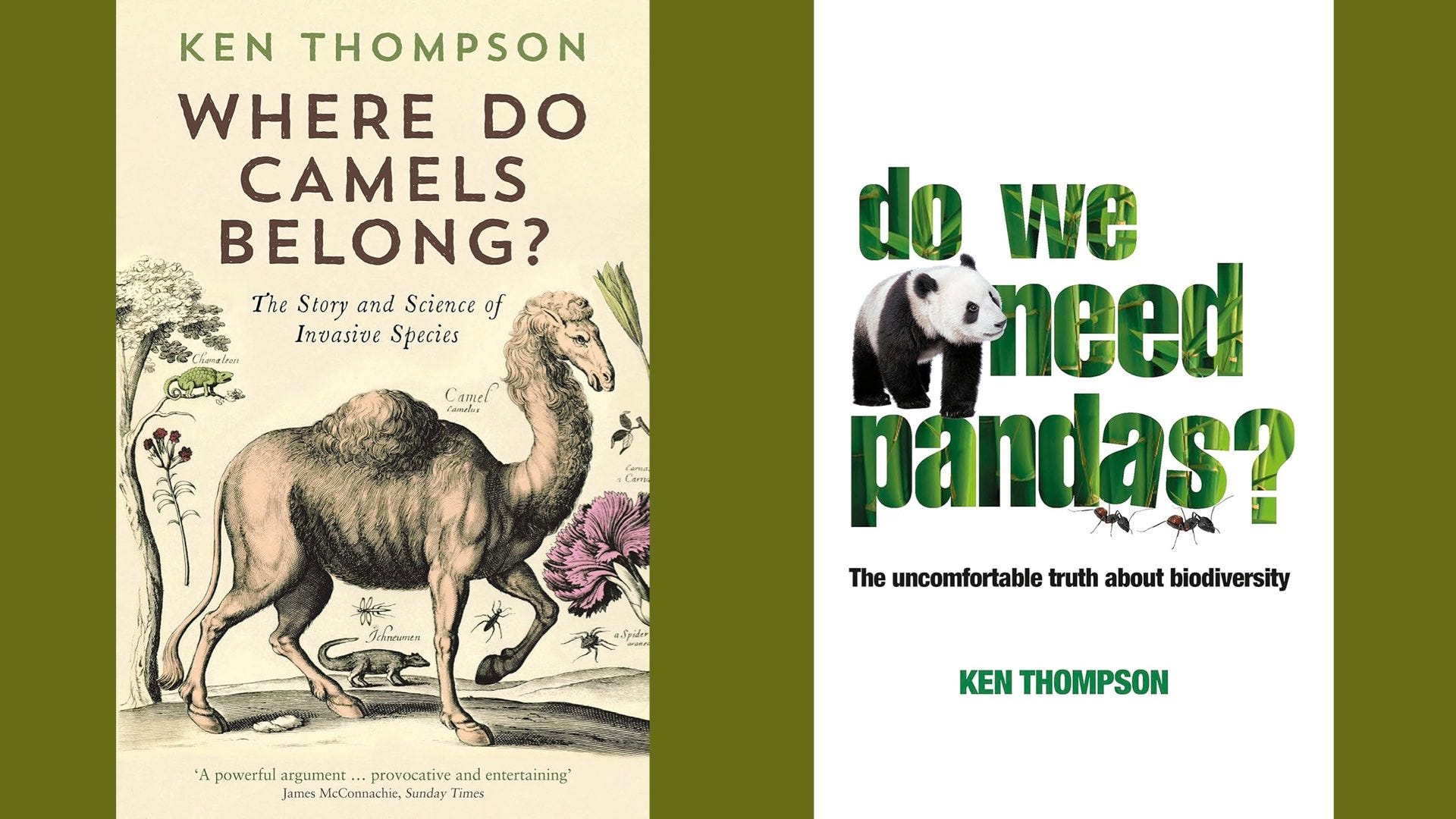
I would like to argue for more of a mystical connection between people and place, animals and land. This could make modern folk uncomfortable. Is this some biological form of Christian Nationalism?
But what about giant pandas? Ken Thompson wrote another book with an even sharper title: Do We Need Pandas? It is another uncomfortable question. Pandas are beautiful, magical creatures. By conventional evolutionary standards they seem remarkably ill-equipped for success. They must eat vast quantities of bamboo in order to get sufficient nutrition to survive. They reproduce very reluctantly and infrequently. If nature is merely “red in tooth and claw,” pandas seem like a species that should have disappeared long ago.
A Different Origin Story
I do not believe nature is merely red in tooth and claw. The Bible tells a different origin story in which animals and man were formed out of the ground, although only mankind is created in God’s image. This is not to say that animals have no value. Not at all. In fact, animals seem to be treated as having a degree of accountability. In a curious passage in Genesis 9:1-17, after the flood in which Noah is given animals, birds and fish for food, God says:
“Be fruitful and increase in number and fill the earth. The fear and dread of you will fall on all the beasts of the earth, and on all the birds in the sky, on every creature that moves along the ground, and on all the fish in the sea; they are given into your hands. Everything that lives and moves about will be food for you. Just as I gave you the green plants, I now give you everything.
“But you must not eat meat that has its lifeblood still in it. And for your lifeblood I will surely demand an accounting. I will demand an accounting from every animal…
You what? Really? Demand an accounting from every animal? How?... In fact, I’m just going to repeat the original question: You what?
“I will demand an accounting from every animal. And from each human being, too, I will demand an accounting for the life of another human being.
“‘Whoever sheds human blood, by humans shall their blood be shed;
for in the image of God has God made mankind.’”
But here’s what’s curious and easy to miss, despite the number of times it’s repeated. I’m sorry, but I’m giving you nine more verses of the Bible to read, but look out for the repetition. It’s astonishing:
Then God said to Noah and to his sons with him: ‘I now establish my covenant with you and with your descendants after you and with every living creature that was with you – the birds, the livestock and all the wild animals, all those that came out of the ark with you – every living creature on earth. I establish my covenant with you: never again will all life be destroyed by the waters of a flood; never again will there be a flood to destroy the earth.’
And God said, ‘This is the sign of the covenant I am making between me and you and every living creature with you, a covenant for all generations to come: I have set my rainbow in the clouds, and it will be the sign of the covenant between me and the earth. Whenever I bring clouds over the earth and the rainbow appears in the clouds, I will remember my covenant between me and you and all living creatures of every kind. Never again will the waters become a flood to destroy all life. Whenever the rainbow appears in the clouds, I will see it and remember the everlasting covenant between God and all living creatures of every kind on the earth.’
So God said to Noah, ‘This is the sign of the covenant I have established between me and all life on the earth.’ (Genesis 9:8-17)
Got that?
Living creatures are to be part of the covenant promise! Humans and animals are covenantally connected. This makes sense given that some can be offered as sacrifices in the place of humans, according to the Mosaic law. It turns out that animals occupy a place much closer to us than modern thinking allows. Evolutionary theory would say that we are nothing but animals. Merely molecular mammals. Creation science might fall into the trap of saying we are nothing like animals, far superior as image bearers of God. But this covenant to Noah places us, well, in the same boat.
Scripture does not treat animals and humans as random collections of cells wandering aimlessly across the earth. The entire Old Testament rests on a promise of a land that God makes to Abraham (Genesis 12). In the New Testament we read that God decided the times and places where we should live. That’s what Paul says in one of my favourite chapters in the Bible, Acts 17:
“The God who made the world and everything in it is the Lord of heaven and earth and does not live in temples built by human hands. And he is not served by human hands, as if he needed anything. Rather, he himself gives everyone life and breath and everything else. From one man he made all the nations, that they should inhabit the whole earth; and he marked out their appointed times in history and the boundaries of their lands.” (Acts 17:24-26)
Humans belong in certain places. And if that is true of people, perhaps it is also true of creatures. Do hares belong in England? Is that a meaningful question? I think it is. We can see that by combining those two book titles by Ken Thompson and ask the question: “Where do Pandas belong?” Easy. China. If you see a giant panda in a zoo, it is on loan from the Chinese government. No-one seems to have a problem with that. Pandas belong in and to China.

What about swans? You may know that the Crown claims ownership of most of the wild swans in Britain. You can’t just help yourself to a swan, not because they are endangered, but because they are regarded as property of the King who is “Seigneur of the Swans”. The Crown and two livery companies check up on the swans on the River Thames in the third week of July. I kid you not.
So much for pandas and swans. What about hares? Where do they belong?

Brown hares are not native to England, whatever ‘native’ means. But they have been present on these shores since the Roman times and through the Anglo-Saxon period. That is when the nation of England was being formed, meaning they have become part of our way of life and culture, mystically and magically creeping around our hedgerows and charging across fields.
The fact is there just is something English about the hare, even though a hare has no idea what England is. Having said that, I don’t think we have any idea what England is either. But one of us should know better.
If you read all the way to the end (well done), you probably enjoyed that. Could you pass that joy onto someone else? Please do share this blog with friends or family that you think would enjoy Cary’s Almanac:
New here? Have you subscribed? It’s free and on Fridays:
In North America, we tend to use "rabbit" and "hare" interchangeably, even though they are different species. Thus, for example, all the Bugs Bunny cartoons with titles based on the "hare/hair" pronounciation formula...