


On 26th October, the Church of England remembers Alfred the Great.
Why? He’s never been canonised. He didn’t perform any attestable miracles. He wasn’t martyred by pagan Vikings. He didn’t die heroically or horribly on the battlefield. What’s so Great about Alfred? And why is he part of the Church of England’s calendar?
That last question has an interesting answer. But in this Almanac entry, I’d like to briefly sketch out the reign of Alfred the Great, often hailed as one of the founding fathers of England, even though he was never King of England. His grandfather, Egbert, was king of a united England ever so briefly in 829. He had defeated the mighty Mercians in 829, soon after which he received the submission of the Northumbrians. But there was a resurgence in Mercia and the fragile union of English kingdoms didn’t last.
Fast forward a hundred years to Alfred’s grandson, Athelstan. Today, he is considered the first true king of England, having conquered the Northumbrians, taking York in 927. One could argue that next year, England is 1100 years old. From that time onwards, there is a recognisable England. Athelstan secured the Kingdom of England against a coalition of Scots, Vikings and Britons at the Battle of Brunanburh in 937.
But without Alfred the Great, there would have been no chance of consolidating a kingdom of united Anglo-Saxons. He dealt with an existential threat to the kingdom itself: the arrival of the Great Heathen Army in 865. Up until this point, Vikings had raided England in smaller parties, stealing, pillaging and killing, then settling for a while before returning home. The Great Heathen Army looked like it was here to stay. And the Vikings were not known for playing nice, assimilating and integrating. (Did I mention the pillaging and killing?)
Alfred the Warrior
Alfred was only around sixteen when this army arrived. His older brothers unsuccessfully tried to hold back these Viking masses and, one by one, died until Alfred was the last man standing, becoming king in 871.
That was the year in which Alfred and his elder brother King Ethelred I faced a Viking army at Ashdown in Berkshire shortly after a West Saxon defeat at Reading. According to Alfred’s biographer, Asser, Alfred attacked before Ethelred had finished hearing Mass, leading the West Saxons uphill, breaking the Viking lines, and winning a hard-fought victory in which several Danish leaders were killed. That makes it sound like Alfred was not devout. He was very devout. Being the youngest son, he may well have been expected to pursue a monastic career.
As we will see, Alfred was clearly a gifted general and a strategic thinker. But the Battle of Ashdown was not a decisive turning point. Fighting continued and the West Saxons suffered numerous defeats at the hands of the Vikings. Ethelred died, leaving Alfred to become king in the middle of the crisis.
Alfred the Warrior King
Over the next seven years, Alfred fought a series of campaigns against the Vikings, making temporary truces and payments when necessary. But it looked like a lost cause, especially after the Viking leader Guthrum mounted a surprise attack on Alfred and his men at Chippenham in 878 during the Twelve Days of Christmas. Very uncool. The Vikings don’t play nice. (Did I mention that?)
This is when Alfred famously retreats to the Somerset marshes, establishing a base at Athelney which, back then, was an island on the levels. It was during this time that Alfred famously burnt the cakes, while dreaming about defeating the Vikings, a curious story that feels too specific to have been pure invention.
What is not in doubt, however, is that Alfred built up his forces and then rallied his troops at Egbert’s Stone, in or around Selwood Forest in Wiltshire. From there he led his fellow Anglo-Saxons into battle at Edington (or Ethandun), not far from where the Westbury White Horse is today.

The Battle of Edington is probably the most significant battle in English history that you don’t know about. (Well done, if you do!) That is surprising because we won, although we won the battle of Ashdown in 871 and you hadn’t heard of that either, had you?
However, battles are two a penny in English history. What happened next is much stranger and significant. It took place at Aller in Somerset. Guthrum and thirty Viking leaders accepted Christian baptism. Alfred became Guthrum’s godfather. Incredible scenes in Aller.
Alfred the Christian Warrior King
Naturally, today, we are sceptical about the efficacy of baptism, let alone the motivations of those being baptised. Some would say it was a ‘forced’ baptism, although Guthrum was not frogmarched to a font at the point of a sword and half-drowned. Make of that event what you will, but it shows us that Alfred realised that the Vikings were here to stay, that he could not eject them and that they would need to be reconciled. The only way to achieve that is not an unending cycle of tit-for-tat violence. It is fellowship and unity in Jesus Christ, the King of Kings.
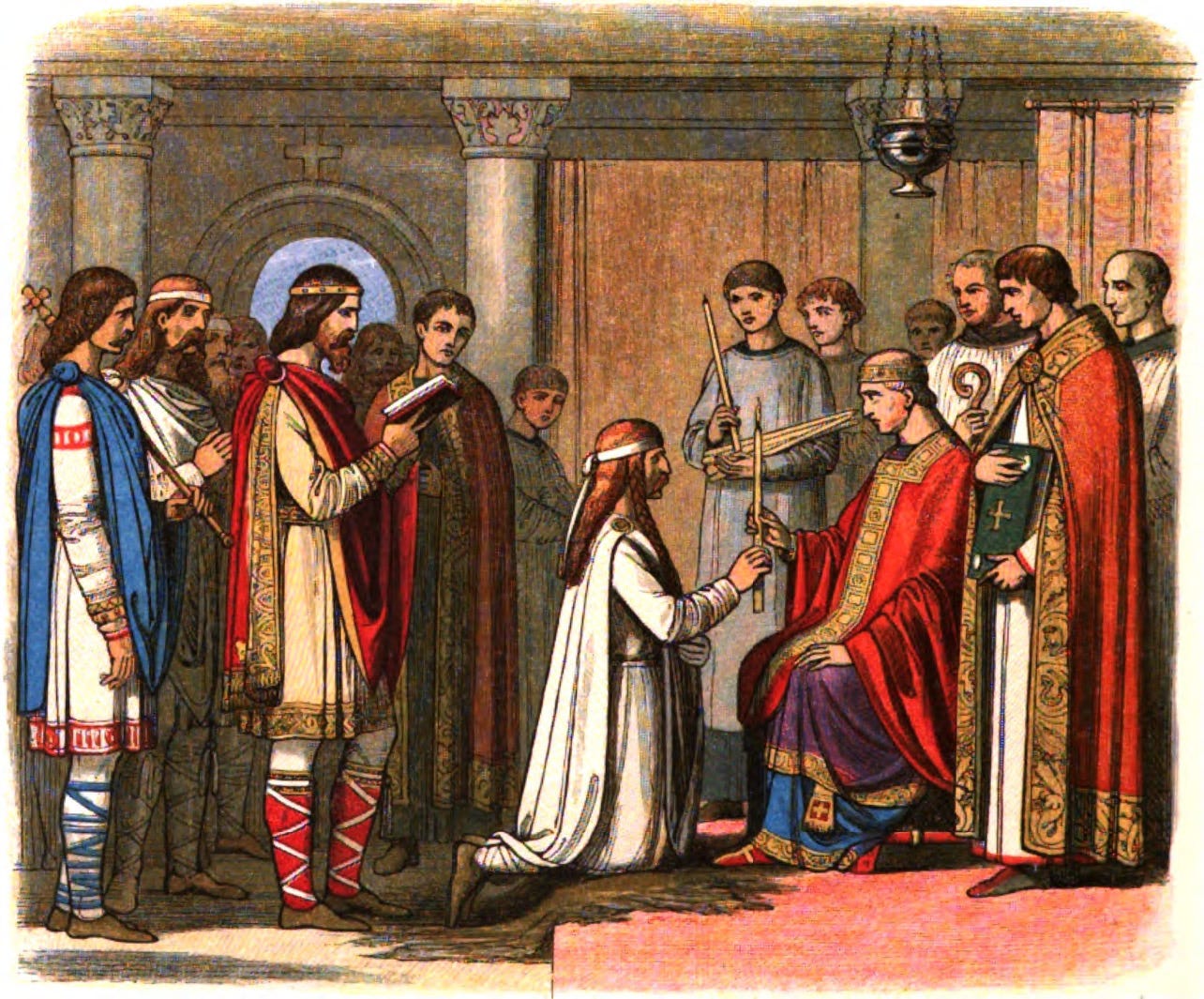
By way of contrast, let us consider how Guthrum might have treated Alfred and his men had they prevailed at Edington. The potentially great king of Wessex could have been dismembered and burned or shot with arrows and then beheaded like King Edmund of East Anglia in 869. I’ve mentioned how they don’t play nice. Why is that?
We rather assume that the Vikings, who were raiders from the sea, could never have been as violent as the legends suggest. But the pagan gods they worshipped were not merely projections of the human psyche. They worshipped real spiritual beings. The Bible calls them principalities and powers who have been defeated by Christ on the Cross. He is the once-for-all blood sacrifice. In baptism, we die with him. And are raised with him to new life.
Whether Guthrum actually believed that or not is neither here nor there in the context of the greater story. The fact is this: the Vikings did not leave England in 878. Many stayed and made their homes in England. More Norsemen arrived, and there was more raiding and plundering. But that all came to an end. How? The bloodthirsty, plundering Vikings were ultimately defeated, partly on the battlefield by Christian kings like Alfred, but ultimately on the Cross, by Christ himself, the King of Kings.
The idea of a Christian Warrior King of England nobly defeating a pagan enemy in battle is, to some Englishmen, very stirring and inspiring. To others, it is embarrassing or even alarming. Why is that? We will look at why Alfred is remembered by the Church of England on 26th October but forgotten by the English next time.
This is really interesting to me mainly because of growing up being taught about ‘KING’ Alfred the Great! An interesting embellishment on the part of my primary school teacher, and interesting that my brain had skipped over any deviations from this perceived truth all these years
Fascinating. Knew very little of this.