

Let’s Get Metaphysical
The Short Life and Exciting Times of George Herbert

On 27th February, the Church of England remembers poet and priest, George Herbert, who died that day in 1633 aged only forty. Born in Wales, educated at Westminster School and then Trinity College, Cambridge, Herbert was set for high office. In 1620, he become Orator of the Cambridge University, typically a stepping stone to greater things. He moved in court circles, but by 1625, his patrons and friends in high places had died. What now? He turned to the church, being ordained priest at Bramerton near Salisbury in 1630. Sadly, George Herbert passed away three years later.
Herbert had become friends with Nicholas Ferrar who is also remembered by the Church of England (1st December). He was the founder of the Little Gidding religious community, a small household devoted to prayer, Scripture, and practical works of mercy. (Little Gidding was, of course, made famous by another great poet, TS Eliot).
Publish or Destroy?
On his deathbed, Herbert sent his manuscripts of poems written throughout his life to Ferrar, asking him to decide whether to publish or destroy them. Since then, millions can be very glad that Ferrar published them, albeit under a title that doesn’t sound quite so appealing today: The Temple: Sacred Poems and Private Ejaculations. Be careful when googling.
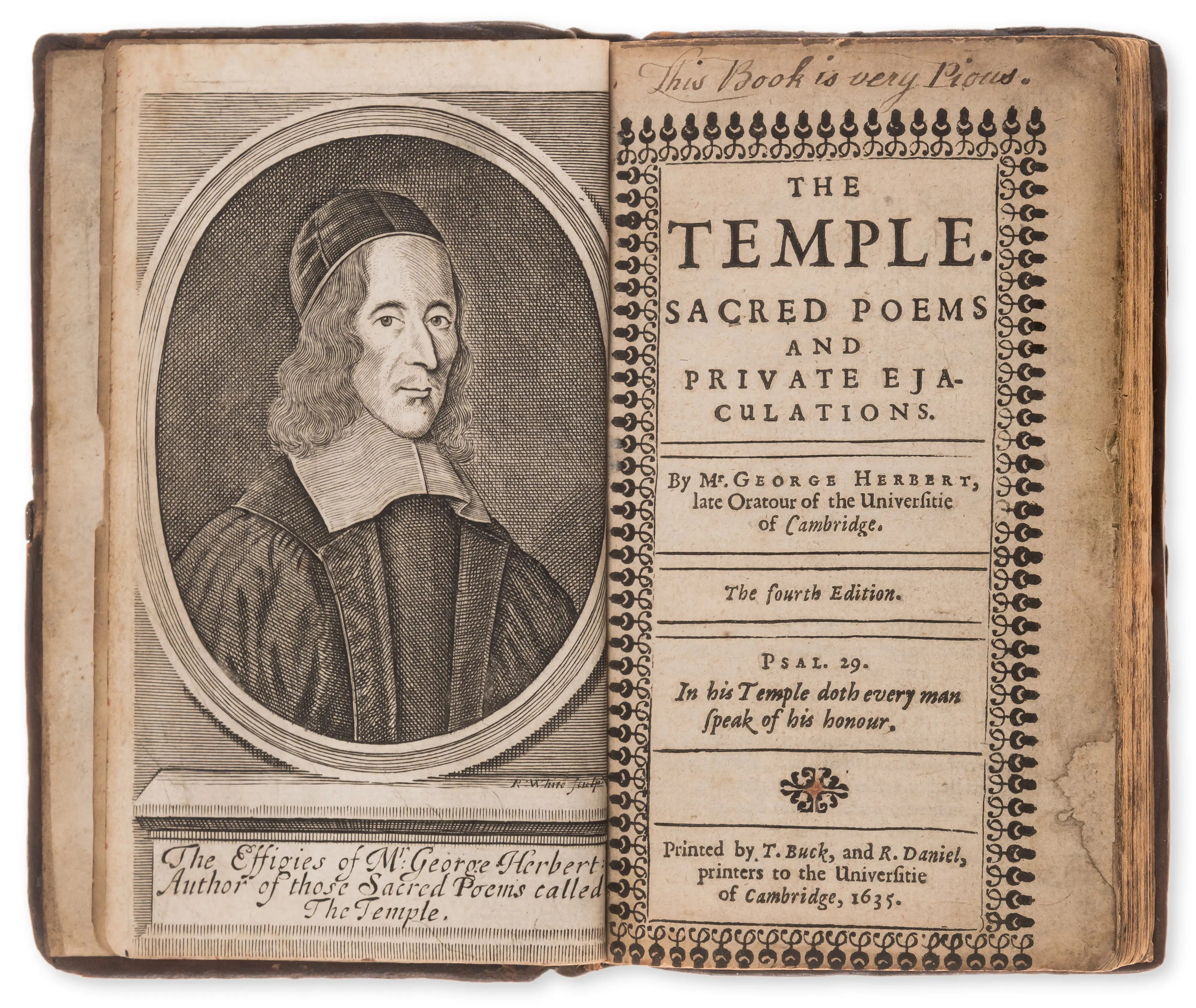
The Temple book was quickly published, printed by Thomas Buck and Roger Daniel, printers to the University of Cambridge. It is recorded in the Stationers’ Register on 19th September 1633. I mention this year because this was the beginning of a period of significant change in England. The so-called Elizabeth Settlement, consolidated during her long reign, was truly beginning to be unsettled.
You will not be surprised to learn that King Charles becomes a problem. By 1633, the king was well into the period of Personal Rule, that is, ruling without Parliament. Running short of money, however, he was forced to raise money through increasingly unpopular un-parliamentary avenues. In 1635, for example, Charles introduced the Ship Money levy to all counties. Until this point, it had normally been paid to the king by coastal counties to maintain ships to prevent raids. Inland ones were now to be charged.
But it was the religious changes that were the most controversial. I’ve written about them before, including how the church of my baptism in my own village of Beckington in Somerset was affected.
However, this is the third instalment on the subject of fasting so let’s focus on that. The king, ruling without Parliament, made a Proclamation “commanding a due execution of Lawes, concerning Lent, and Fasting dayes” in Greenwich on 24th June 1632. This proclamation was then vigorously enforced by the new Archbishop of Canterbury, William Laud following the death of George Abbot in 1633. Laud, as we saw last month, insisted on numerous controversial innovations that, far from bringing the nation together as Charles the First had hoped, set England on a path to civil war.
George Herbert, whose life was cut short at the age of forty, was, at least, spared the agony of seeing his nation and church fight each other in battle. He will be remembered as one of the metaphysical poets (a title which also applies to John Donne who is remembered on 31st March).
The Temple: Sacred Poems and Private Ejaculations contains a poem about Lent which, itself contains a line in the first verse which sums up the whole business of Lenten Fast:
The Scriptures bid us fast; the Church sayes, now:
Here is the poem in full. I encourage you to read it, slowly, to the end. Or you can hear me read it at the end of the latest episode of The Stand Up Theologian podcast in which I read aloud all three posts on Fasting:
Welcome deare feast of Lent: who loves not thee,
He loves not Temperance, or Authoritie,
But is compos’d of passion.
The Scriptures bid us fast; the Church sayes, now:
Give to thy Mother, what thou wouldst allow
To ev’ry Corporation.The humble soul compos’d of love and fear
Begins at home, and layes the burden there,
When doctrines disagree.
He sayes, in things which use hath justly got,
I am a scandall to the Church, and not
The Church is so to me.True Christians should be glad of an occasion
To use their temperance, seeking no evasion,
When good is seasonable;
Unlesse Authoritie, which should increase
The obligation in us, make it lesse,
And Power it self disable.Besides the cleannesse of sweet abstinence,
Quick thoughts and motions at a small expense,
A face not fearing light:
Whereas in fulnesse there are sluttish fumes,
Sowre exhalations, and dishonest rheumes,
Revenging the delight.Then those same pendant profits, which the spring
And Easter intimate, enlarge the thing,
And goodnesse of the deed.
Neither ought other mens abuse of Lent
Spoil the good use; lest by that argument
We forfeit all our Creed.It’s true, we cannot reach Christs fortieth day;
Yet to go part of that religious way,
Is better then to rest:
We cannot reach our Saviours puritie;
Yet are we bid, Be holy ev’n as he.
In both let’s do our best.Who goeth in the way which Christ hath gone,
Is much more sure to meet with him, then one
That travelleth by-wayes.
Perhaps my God, though he be farre before,
May turn, and take me by the hand, and more
May strengthen my decayes.Yet Lord instruct us to improve our fast
By starving sinne, and taking such repast
As may our faults controll:
That ev’ry man may revell at his doore,
Not in his parlour; banquetting the poore,
And among those his soul.
That’s the final post of my mini-Lenten series. Whatever you decide to do with those forty days, plus Lord’s Days, it is good to prepare for Easter spiritually.
Can I help with that?
I’ve written an e-book of 41 short devotionals based on the Psalms. It’s called Psalm Psupplement. It is not a set of vague and sentimental reflections. That doesn’t sound like me, does it? No, it’s a clear, honest, thoughtful journey through some Psalms that remind you that you are more in need of God than you knew, and more loved than you could believe.
This isn’t mysticism. It’s steady, rooted Christianity; the kind you’ve come to expect here at Cary’s Almanac.

Psalm Psupplement is not a set of devotions written by a pastor who has preached his way through some Psalms and converted them into sermonettes. These have been worked up over months by a BBC comedy writer who has spent his life working out what rings true and what falls flat. That perspective makes this book different.
It isn’t flashy. It isn’t sentimental. It isn’t trying to impress you. It’s trying to root you by a river of a flowing, fresh water so that you can grow and flourish. Why not give it a try for Lent? It’s not available on Amazon. But you can have a version you can upload to Kindle, iBooks or Kobo. Or just an old school PDF: