

From Fireworks to Fright Night
The Curious Fall of Bonfire Night and the Rise of Halloween

I buy all my clothes from T.K. Maxx. It’s just easier. If they have a blue or a white shirt my size in a brand I like, I’ll buy it because I will need it sooner or later. And I don’t just pop in for shirts. They also sell cheap Moleskine notebooks, and although they are often garish colours or odd sizes, I find it very difficult to resist buying them.
So I regularly pop into T.K. Maxx, but in early August I was startled to see Halloween items for sale. Wow. Halloween comes earlier every year.
It should not be a surprise since Halloween is now acknowledged as the single biggest festival in the UK after Christmas. In 2023, Consultancy.uk reported “New research suggests that spending on the ancient pagan celebration will pass £1 billion for the first time in 2023.” (More on that ‘ancient pagan’ assertion in a moment.)
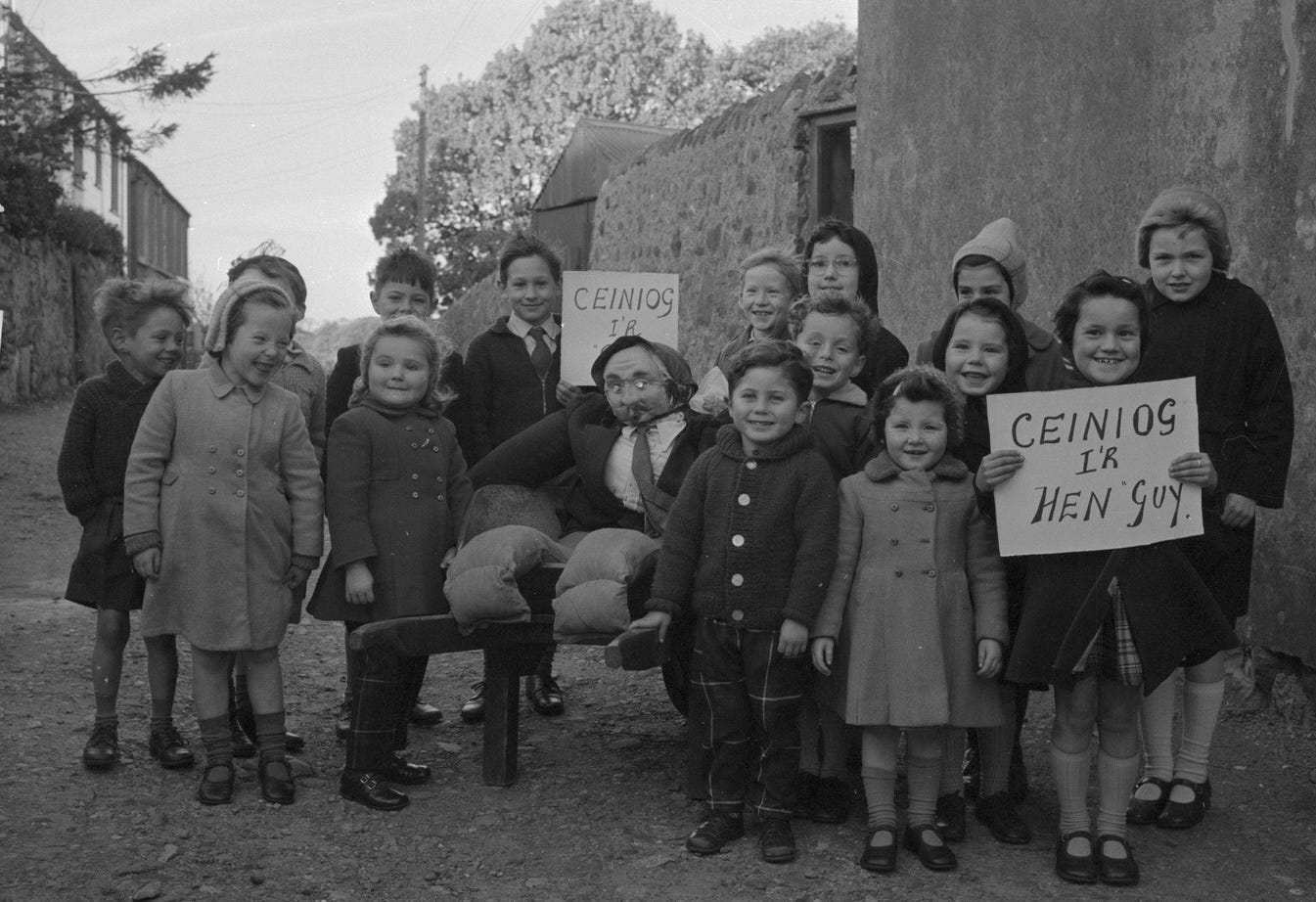
This is very odd for a Gen X-er like me. Back in the 1980s, Bonfire Night on 5th November was far more exciting. It involved sparklers, fireworks and a huge bonfire in which you got to burn a guy, which was essentially a set of second-hand clothes stuffed with old newspaper or straw. Put like that, it all sounds a bit Wicker Man, doesn’t it? But it was great fun.
The guy I would make with my sisters was often wearing my dad’s old clothes, and was stuffed with straw from the farm where I was raised. And so, every year as a child, I’d burn a life-sized puppet of my dad. That’s pretty dark, isn’t it? But it was the 80s. My dad is great. And we didn’t overthink this sort of thing back then. We were more worried about the Miners’ Strike and the Cold War degenerating into a nuclear holocaust.
.jpg)
Where did you go, Guy?
Forty years later, Guy Fawkes Night is a slightly embarrassing social event celebrating the death of a Roman Catholic traitor at a time when Catholics are attending church as much, if not more, than their Anglican neighbours. Perhaps this is why Bonfire Night has been eclipsed by the revival of a much older festival, Halloween.
Some love to undermine Christianity by saying that Halloween dates back to pre-Christian times (as if that implies greater legitimacy or purity than the later faith). That was the assumption of whoever wrote the article above for Consultancy.uk. In his highly informative and well-researched The English Year, Steve Roud writes “Hallowe’en is probably the most widely misunderstood and misrepresented day in the festival year, but so many now believe that it was originally a pagan festival of the dead that this belief is virtually impossible to shake.”
The Real Roots of Halloween
All Hallows Eve (Hallowe’en) is a by-product of All Hallows Day. This was officially established in the Christian church on 1st November (having been originally celebrated in May) in the 8th century by Pope Gregory III. It was to be a memorial service at St Peter’s Basilica in Rome for all Christians, not just the celebrated martyrs. In 837AD, Pope Gregory IV extended the feast day to the entire Church.
All Hallows Day, and the following All Souls Day (2nd November) took on a different character in the 13thcentury as belief in purgatory began to take root. Purgatory was believed to be a place where you went after death to have your sins purged. After all, goes the theory, we are all so sinful we can’t just go to be with the Lord when we die. We have sins that need to be burned off.
The very doctrine was the starting point for the Reformation. By 1517, the church had monetised indulgences to raise funds for the rebuilding of St Peter’s Basilica in Rome. Germans were invited to reduce time spent in the fires of Purgatory for a small fee. Reformers challenged this doctrine, not least by quoting passages like Hebrews 10:12-14 from their new Bibles recently translated into their own language:
When Christ had offered for all time a single sacrifice for sins, he sat down at the right hand of God, waiting from that time until his enemies should be made a footstool for his feet. For by a single offering he has perfected for all time those who are being sanctified.
Purging for sins is neither necessary nor possible. Nonetheless, before the Reformation, All Hallows Day could mean requiem masses and bell ringing to assist the dead into heaven. But that was about it.
Trick or Treat
The practice that became “Trick or Treating” had its roots in Mischief Night that took place at other times of the year (like May Day Eve on 30th April), but seemed to coalesce around 31stOctober in the 1950s. Soon afterwards, British culture began to be influenced by American television. For decades, American sitcoms have had its characters trick-or-treating at some point in a season. It’s a great excuse to have them wear fancy dress or the costume of a superhero.
In fact, one of my favourite sitcom jokes of all time takes place in the Halloween party episode of Frasier from 1997:
The Secrets Revealed by Hallowe’en
The resurgence of Halloween reveals many things about our society. It might be part of the ‘quiet revival’ and the yearning for the spiritual which is happening across the religious spectrum. People are joining the Roman Catholic church or becoming witches in growing numbers. The age of atheism has passed. In fact, culturally speaking, it was a blip. That’s the assertion of Glen Scrivener on the next episode of The Stand-Up Theologian podcast that drops on Monday. This follows on from my discussion with Dr Andy Bannister as we wonder why atheism just isn’t funny anymore.
Assuming scepticism is on the wane, it would be a good idea for Christians to grab Halloween and use it to tell stories of how the demons shrieked at the name of Jesus, or how Saul consulted a witch and was condemned by the ghost of Samuel. (I have a joke about that in The Wycliffe Papers.) The devil doesn’t have all the best stories. Christians do.
We could also acknowledge that our fragmented society has spent a decade staring at screens and is now yearning to do something together. It will grab any festival it can, even one that is potentially spiritually harmful. So why don’t we lean into other festivals? Allow me to continue to bang the drum for the Christian calendar with these three contenders:
Holy Cross Day (15th September) We can celebrate the very cross where Christ offered for all time a single sacrifice for sins. Feels a bit Eastery? Been done? Then how about this next one?
Michaelmas (29th September). Let’s celebrate the death of the great serpent, slain by the Archangel Michael and his angelic host. What’s not to like?
Want an excuse for a bonfire? Rather than remember Guy Fawkes – who was not burned – let’s remember some Protestant martyrs who were:
The Commemoration of Bishops Hugh Latimer and Nicholas Ridley (16th October) Two heroes of the faith were burned on a pyre in Oxford on that day in 1555. And if we celebrate our Christian history deliberately for many years, we could change the culture. And who knows? You might be able to buy a Hugh Latimer doll at T.K. Maxx.
As it happens, I’m making a video about Hugh Latimer for 16th October. Have you see my video on Bishop Hooper suffered a similar fate?
Seen the latest headlines at The Wycliffe Papers
Why isn’t Atheism Funny Any More?
The Stand-Up Theologian podcast continues as I ask that question to Dr. Andy Bannister who returned to his book The Atheist Who Didn’t Exist for a 10th anniversary edition, reflecting on how things have changed since the days of Richard Dawkins, Christopher Hitchens, and the “new atheism.” What can we learn from comedy landmarks like Life of Brian, Father Ted, Ricky Gervais, or the contrast between The Simpsons and Family Guy? Why are comedians so often drawn to religion, and can humour really open the door to deeper reflection? Even sceptics like David Baddiel and Douglas Murray admit to yearning for God—why do they never seem to get there? Plus, there's an intriguing story about John Newton’s doubts about his conversion.
You read all the way down the bottom! Well done. Gold star for you. Have a lovely weekend.
Please imagine here suitable emotica for clapping hands, laughing out loud etc. There is a trend even in religious Ulster where I live for humanist funeral ceremonies, even worse I imagine than a pagan funeral, not that I have ever been to one of those. We do need to have more sermons on what happens when you die, and not just at funerals.
Great post, James. Thanks!